
Periodic maintenance of heat interface units
Maintenance on a heat interface unit is more than a visual inspection. In every dwelling we work through the same list, test the unit, record the meter readings and deliver a report with photographs for each dwelling. That tells you the condition of every connection in your portfolio.
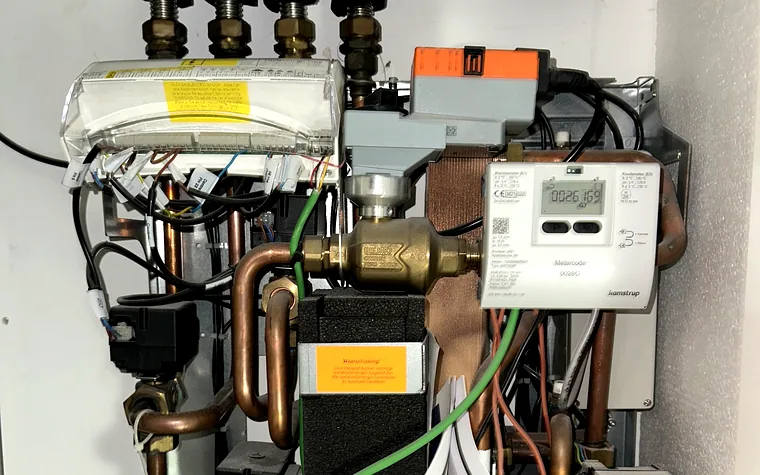
- 34 check points
- The same list in every dwelling, from power supply to cover panel
- A photograph with every finding
- Recorded per dwelling, with date and engineer
- Safety check beforehand
- Every dwelling starts with a risk assessment
What periodic maintenance gives you
Preventive maintenance does not bring the number of faults down to zero. What it does do is make the faults that remain predictable, and record the condition of your portfolio. After a maintenance round you know, for every dwelling, which unit type is fitted, what year it dates from, which meter sits under it and what is wrong with it.
- Fewer failures during the heating season, because filters, valves and controls have been checked
- A record per dwelling with which you can demonstrate that the maintenance was carried out
- An up-to-date overview of unit types, years of manufacture and meter numbers
- Findings with which you can plan and budget for replacement
That last point is usually the most important one for an asset manager. A unit in poor condition appears in our report before it fails.
One list, the same in every dwelling
For each project we work with a single maintenance form, matched to the unit type fitted there and to the client's protocol. Every engineer works through the same points in the same order. That makes the reports for four hundred dwellings comparable, and leaves no difference between one engineer and another.
At the top of the form we record what is fitted: address, make and unit type, year of manufacture, the serial number of the energy meter, and the engineer's name with date and signature. If your own records no longer match what is fitted in the dwelling, that is where it shows.
Before the engineer starts on the unit he carries out a last-minute risk assessment, known in the trade as the LMRA. Nine questions: is the work area tidy and safe, has that part of the installation been made safe, does he know where the escape routes and fire extinguishers are, does he know the work to be done, does he consider the working method safe, does he have the right personal protective equipment and tested tools, and has he consulted anyone else working in the same space. Those questions are on the same form and are signed off for every dwelling.
What we check on the unit
After the safety check comes the installation itself. Eighteen points, the same in every dwelling.
- Power supply present, domestic water present and the display of the energy meter active
- In-home system filled and vented
- Pipework on the correct connection, with flow and return not reversed
- The unit and the pipework checked for leaks
- Inlet combination valve present, and an expansion vessel where one belongs
- Insulation complete and undamaged, no deterioration and no corrosion underneath
- Wiring correctly connected and neatly finished, cover panel present and fitted
- Mounting, fixings, connections and the fill and drain points
Corrosion under the insulation is the point that most often turns something up. A coupling rusting away underneath becomes a leak in time, and a leak in a meter cupboard is a report that reaches you at an inconvenient moment.
What we test and measure
A unit can look fine and still not work properly. That is why every unit is tested and not merely inspected.
- The heating is tested in operation
- The changeover valves are checked for operation: the valve that switches between domestic hot water and heating, the valve in the return and, on a unit that also supplies cooling, the valve between heating and cooling
- The main control valve and the flow sensor on the domestic hot water are checked
- The circulation pump is set to the prescribed setting
- An external heat or cooling demand is generated; the unit has to respond to it
- The dirt strainers are removed, cleaned and refitted
- The meter readings are taken: the heat meter and, on a unit that also supplies cooling, the cooling meter separately
- A hot water test at the tap, recording how many seconds it takes for the water to reach temperature
That last measurement says something in a single figure about the whole domestic hot water line: the flow switch, the control and the transfer in the heat exchanger. If that figure rises across a complex, it is the first signal, well before the first resident calls.
Access to the dwelling
A heat interface unit sits behind the front door. No resident, no maintenance, and in practice that is where most of the time goes. We take that work off your hands.
- We make the appointments ourselves, per dwelling, in time slots
- Including evenings where that is agreed with you, so that working residents do not have to take a day off
- Dwellings where nobody was in come back on a second round, not onto a list that sits there
- We keep track of which dwellings are still outstanding and report that back to you
The announcement from your organisation stays with you. We introduce ourselves to the resident as SVS Warmteservice, partner of your organisation: we act on your behalf, under our own name. That is clear for the resident and it keeps the responsibility where it belongs.
The report per dwelling
Every dwelling produces one report, signed by the engineer and dated. It sets out what was checked, what was measured and what was found. Photographs are part of it: of the unit, of the meter reading and of every finding that needs follow-up. Where there is a leak, a photograph is mandatory.
At the end of the visit the engineer records three things: that the installation was left in working order, that the area was cleaned up, and what his overall impression of the installation is. That last line is not a formality. An engineer who notes that there are many old signs of leakage and that the unit is in poor condition is writing the first sentence of a replacement recommendation.
If you work with your own management or records system, we supply the data in the form it arrives there. If the engineer finds something that falls outside the maintenance, we inform the managing agent of it in writing; that is a separate point on the form.
What follows from the maintenance
Maintenance is not an end in itself. The findings from a round go three ways.
- Minor defects we put right on the spot, during the same visit
- Units at the end of their service life go onto a replacement list, with a photograph and reasoning: see replacing heat interface units
- Whatever you have to decide or tender yourself we put to you, with a recommendation
The same data shows which complexes and which unit types cause the most faults. That determines where the next round goes first and what the call-out service has to allow for. The periodic maintenance on the district heating substation serving the complex we schedule into the same round: see maintenance of district heating substations.
We work throughout the Netherlands, with Houten as our base.
Frequently asked questions about heat interface unit maintenance
What exactly do you check when maintaining a heat interface unit?
Thirty-four numbered points per dwelling, plus nine safety questions beforehand. Those cover eighteen checks on the installation, the functional test of the valves, the main control valve, the flow sensor and the pump, the meter readings, the dirt strainers, a hot water test and the closing checks. All on one form, the same in every dwelling.
How often does a heat interface unit need maintenance?
That is set out in the contract and differs per client and per unit type. Many clients opt for a fixed cycle in which every dwelling comes up within an agreed period. We advise on the interval per type and keep track of which dwellings are still outstanding.
Are the dirt strainers cleaned?
Yes. The dirt strainers are removed, cleaned and refitted; on most unit types there are two of them. A silted-up strainer restricts the flow and is one of the most common causes of complaints about hot water.
Does the resident have to be in?
Yes. The heat interface unit sits behind the front door. We make the appointments with residents ourselves, including evenings where that is agreed with you, and schedule a second round for the dwellings where nobody was in.
What happens if the engineer finds something wrong?
Minor defects he puts right during the same visit. Anything that needs follow-up goes into the report with a photograph, and we inform the managing agent of it in writing. Where there is a leak, a photograph is mandatory.
Do you also maintain units that supply both heating and cooling?
Yes. On a unit that also supplies cooling we record the heat meter and the cooling meter separately, and we test the valve that switches between heating and cooling and the unit's response to an external cooling demand.
Would you like to know what a maintenance round in your portfolio involves?
Tell us which complexes are involved and which unit types are fitted. We will draw up the maintenance form and set out how we would organise the round.
Our other services
Service and maintenance for heat interface unitsCall-out service and maintenance for heat interface units of every make District heating substation maintenanceMaintenance on the substation that connects the building to the network Commissioning of heat interface unitsCommissioning heat interface units, with a report per dwelling Back Office as a ServiceWe take over the customer contact and the administration Radiator and underfloor heating serviceWe resolve the complaints that do not sit with the unit Thermostats and controlsChoosing, setting up and explaining the controls Service & maintenanceContracts, the call-out service 24 hours a day and the Heat Act