
Radiator and underfloor heating service
The heat emitters are the last link in the chain. They decide what the resident feels and what return temperature comes back to you.
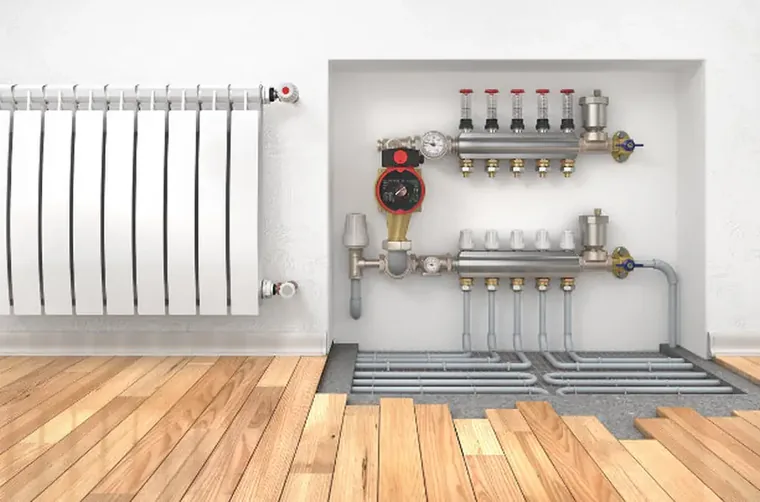
- Return temperature
- Balanced emitters send the water back colder
- Circuit by circuit
- Setting the flow meters on the manifold individually
- Low temperature
- We judge whether the capacity matches the network
What we solve for you here
We take on the complaints that technically do not sit with the heat interface unit but that you get held to account for anyway. A radiator that will not heat up, a floor that stays cold, a room that simply never gets there. In district heating many parties' responsibility stops at the unit. Technically that is correct. Practically it is not.
There is something else at play, and it hits your operation directly. A heat network performs better the colder the water comes back. Emitters that are fouled, hold air or were never balanced give up their heat poorly and send water back too warm. That costs transport capacity and efficiency across the whole branch, not just in that one home. The emitters are therefore not a side issue behind the front door but a variable in your own operation.
What goes wrong in practice
- Air in the radiators or in the manifold, so part of the system does not contribute
- Fouling and corrosion sludge in older systems, choking the flow
- Thermostatic valves that seize after years and no longer close
- A manifold that was never balanced: the nearest circuit takes everything
- Emitter capacity that does not match a lower flow temperature
- Underfloor heating and radiators on the same circuit with no separation
What we do
- Venting and repressurising, and establishing why air got in
- Setting the flow meters on the manifold circuit by circuit
- Replacing thermostatic valves and radiator lockshields
- Flushing where there is fouling, and fitting a filter where that helps
- Measuring flow and return temperature and assessing the difference
- Judging whether capacity matches the network's flow temperature
- Explaining to the resident what was done and what they can do themselves
Lower flow temperature, higher demands
Heat networks are moving to lower flow temperatures. That is good for efficiency, but it makes the emitters more critical: with a smaller difference between flow and room temperature, more surface area is needed to give up the same heat. A radiator that was comfortably adequate at high temperature can fall just short at a lower flow. And the resident notices that on precisely the coldest day.
We assess that home by home and say honestly when replacing makes more sense than balancing. Over the whole life of the system, a larger radiator or an extra circuit is sometimes the cheapest answer.
Who we do this for
Heat suppliers and energy operators receiving complaints that technically do not sit with the interface unit, housing associations and managing agents with district heating systems, and contractors left with snagging inside the homes after handover.
We work throughout the Netherlands, with Houten as our base.
Wondering what this means for your installations?
Tell us what is going on. We will think it through with you, and say so honestly if something is not a fit for us.
Our other services
Service and maintenance for heat interface unitsCall-out service and maintenance for heat interface units of every make Maintenance of district heating substationsMaintenance on the substation that connects the building to the network Commissioning of heat interface unitsCommissioning heat interface units, with a report per dwelling Back Office as a ServiceWe take over the customer contact and the administration Thermostats and controlsChoosing, setting up and explaining the controls Service & maintenanceContracts, the call-out service 24 hours a day and the Heat Act